
KRI VS KPI
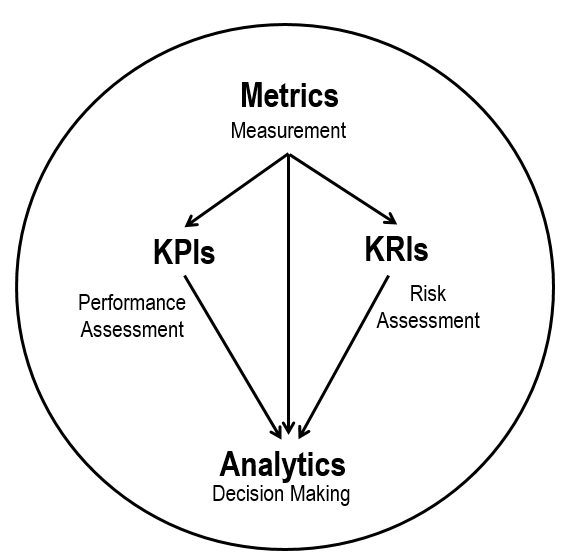 If you are in charge of a business unit, department or team, what do you need to do to justify its existence? What are you and your team expected to accomplish to fulfill your respon sibilities?
The tendency of many people is to focus on the activities of each day instead of the end results expected from them. You can become busy with the daily activities of the job that you lose sight of the results required altogether.
A key result indicator is a financial and non-financial measure that is used to help an organization measure progress towards organizational goals or objectives.
 KRIs are the measures that tell you how well you’ve done in terms of your larger objectives and provide a clear picture of whether you are in the right direction. You can view these as being at the strategic level, measuring how well the selected strategy is working; as well a KRI measures the results from your business actions, which are critical in tracking progress and defining success. One of the most important objectives of KRIs is that Business strategy can be captured under a Balance Scorecard where each of the areas within the business plan can be measured through Key Result Indicators. KRIs exist to tell management and shareholders if the organization is operating well, but what they don’t know, and mistakenly use KRIs for, is provide any insight or direction into what actions are successful and which are not.
A key performance indicator is an action that if acted upon will result in an improvement in a key result indicator. The identification and measurement of key performance indicators help to ensure the success of the key result indicator and are the steps that need to be taken for a successful result.
While KRIs are important in determining if the goals have been met, they cannot help you achieve or improve these goals; they are simply benchmarks (which are still crucial to a company’s definition of success). KPIs focus on the actions that lead to the results; it’s this information that’s critical in creating strategies and aligning goals, which can hinder a company’s success.
Look at KPIs and KRIs (KRI VS KPI) and think of your business as a football team. The manager is interested in the overall wins and trophies that a team has amassed (KRIs), similar to the board of a company. On the other hand, the coach is more interested in how the players are performing and the advanced statistics that show them where the team can improve (KPIs), similar to management in a company. In this scenario, the manager is concerned with KRIs, while the coach/management is more occupied with KPIs. Both sets of metrics have incredible purpose towards the success of the company, but the two are used and looked at in two different ways.
Distinguishing between (KPIs) and (KRIs) can improve clarity and help focus attention where it matters most.so, after having an overview on KRI VS KPI how will they affect your department, team and company in general?
Tag:Human Resources